By Sami Zaptia.
London, 1 May 2017:
Libya’s oil revenues, oil production and foreign reserves were down while its accumulative deficit was up, the Tripoli-based Audit Bureau reported in its 623-page 2016 Annual Report released on 26 April.
The economic section of the report concluded that Libya recorded its lowest state revenue in 2016 in its modern history.
Libya achieved LD 8.6 billion (bn) in state revenues but state outgoings were LD 30 bn leaving it with a deficit of LD 21 bn. This 2016 deficit when added to the deficits of 2013 to 2015 totalled a cumulative deficit of LD 57 bn, the Audit Bureau stated.
| Year | Actual revenues | Actual spending | Surplus (deficit) |
| 2012 | 70 | 49 | 21 |
| 2013 | 55 | 65 | (10) |
| 2014 | 22 | 44 | (22) |
| 2015 | 11 | 36 | (25) |
| 2016 | 9 | 30 | (21) |
| Total | 167 | 224 | (57) |
Libya’s actual revenues, spending and surpluses/deficits 2012-2016 in billion Libyan dinars according to the Tripoli-based Audit Bureau.
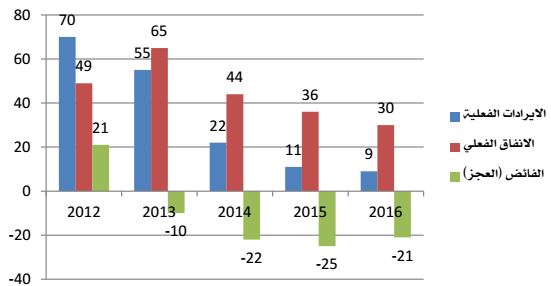
Blue: Actual Libyan state revenues Red: Actual Libyan state spending Green: Surplus or (deficit) in LD billions according to the Tripoli-based Audit Bureau.
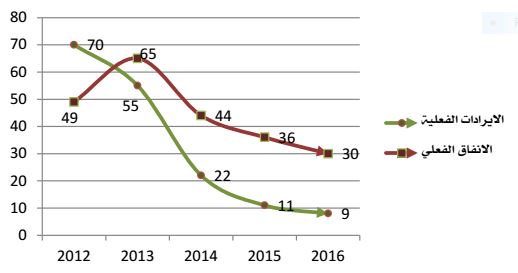
Green: Actual Libyan state revenues Brown: Actual Libyan state spending 2012 to 2016 according to the Tripoli-based Audit Bureau.
| Description | Amount in million dinars |
| Loans for 2014 | 21,711 |
| Loans for 2015 | 19,172 |
| Loans for 2016 | 20,676 |
| Total loans 2014-2016 | 61,559 |
| Taken from reserve account | (15,000) |
| Total government debt owed to CBL | 46,559 |
The Libyan government has been able to cover its deficits since 2014 by borrowing from the CBL. The total amount borrowed by successive governments since 2014 to 2016 was LD 61.6 bn. The CBL was able to recoup from reserves LD 15 bn from this, giving a new total outstanding debt to the CBL of LD 47 bn.
The Audit Bureau reported that Libya lost US$ 106.589 (LD 149.225 bn) worth of oil revenue or 15.56 bn barrels of oil production from mid-2013 to the end of 2016 as a result of the ‘‘crime’’ oil port closures by the Petroleum Facilities Guards.
| Year | Ave price of barrel in US$ | Actual production (million barrels) | Lost oil production (million barrel) | Lost oil production (million US$) |
| 2013 | 116 | 362 | 222 | 25,752 |
| 2014 | 88 | 175 | 409 | 35,992 |
| 2015 | 52 | 124 | 460 | 23,920 |
| 2016 | 45 | 119 | 465 | 20,925 |
| - | Total production loss 2013 to | - | Total US$: | 106,589 |
| 2016 due to port closures | Total LD: | 149,225 |
Oil production and revenue losses due to port closures 2013-2016 according to the Tripoli-based Audit Bureau.
The Audit Bureau also noted how Libya’s oil revenues steadily declined reflecting its decline in its oil production and the average price of the barrel of oil it accrued in the period from 2013 to 2016. Hence, whilst in 2013 the average price Libya accrued from one barrel of oil was US$ 116, this crashed steadily, as international crude oil prices plummeted, to US$ 45/barrel. Commensurately, Libya’s oil production crashed from 362 million barrels per annum in 2013 to 119 million barrels/per annum in 2016.
| Description | 2013 | 2014 | 2015 | 2016 |
| CBL balances & deposits | 106 | 77 | 54 | 58 |
| Reserve balance | 17 | 17 | 17 | 2 |
| LIA deposits | 23 | 23 | 23 | 23 |
| Total in LD | 146 | 117 | 94 | 83 |
| Equivalent in US$ | $ 116 | $ 88 | $ 67 | $ 58 |
| Exchange rate | 1.2527 | 1.3331 | 1.3891 | 1.4379 |
The balances of and deposits of the CBL also declined sharply between 2013 and 2016 from a high of US$ 116 bn in 2013 down to US$ 58 bn in 2016.
The Audit Bureau reported that as a result of the continued decline in oil production which reached its lowest level in 2016, down to 119 million barrels and earning US$ 4.735 bn (LD 6.6 bn). This contrasts with overseas foreign currency transfers amounting to US$ 12 bn (LD 16.6 bn) leading to a balance of payment deficit of US$ 7 bn (LD 10 bn)
The fast depletion of the CBL’s hard currency reserves forced the Central Bank to cut back severely on foreign currency overseas transfers in 2015-16 to its ‘‘lowest levels’’. This did succeed in reducing the depletion of its foreign currency.
However, this also led to such a shortage of the availability of hard currency within the domestic Libyan market that it forced the black market exchange rate of the US dollar to rise sharply. The devaluation of the Libyan dinar had severe knock-on effects on inflation, price hikes and a degradation in Libyan citizen’s spending power and quality of life.